Stunting Isn't a Height Problem — It's a Country Problem
One in five Kenyan children under five is stunted.
Read that again.
We say it like a statistic. It is a verdict on a generation. Stunting is not a height problem. It is a brain problem, an economy problem, and a country problem dressed up as a child-by-child concern.
We have spent a decade earnestly programming around it. We have moved the needle some. We have not moved it enough. And the reasons are not the ones the brochures say.
Table of Contents
- What Stunting Actually Is
- Why It Persists Despite The Programs
- What's Missing From The Conversation
- What Would Actually Move The Needle
- What This Means For Anyone Reading
What Stunting Actually Is
Stunting is what happens when a child's growth is chronically suppressed during the first 1,000 days — from conception to two years old.
It is measured as height-for-age more than two standard deviations below the WHO reference. The cut-off sounds clinical. The lived experience is not. By the time a child is stunted, you can usually see it: smaller stature, often slower speech development, often slower school readiness. Some of these gaps close with later good nutrition. Most do not. The lifelong loss is in earnings, in school years completed, in resilience to illness.
Across populations, stunting is one of the strongest predictors of adult outcomes we have. A country's under-five stunting rate at year T is a startlingly good predictor of its productivity loss at year T+25.
Kenya's rate has hovered around 18–22% nationally for most of the last decade. Some counties — Kitui, West Pokot, Kilifi, parts of Turkana — sit above 30%. We have stalled.
Why It Persists Despite The Programs
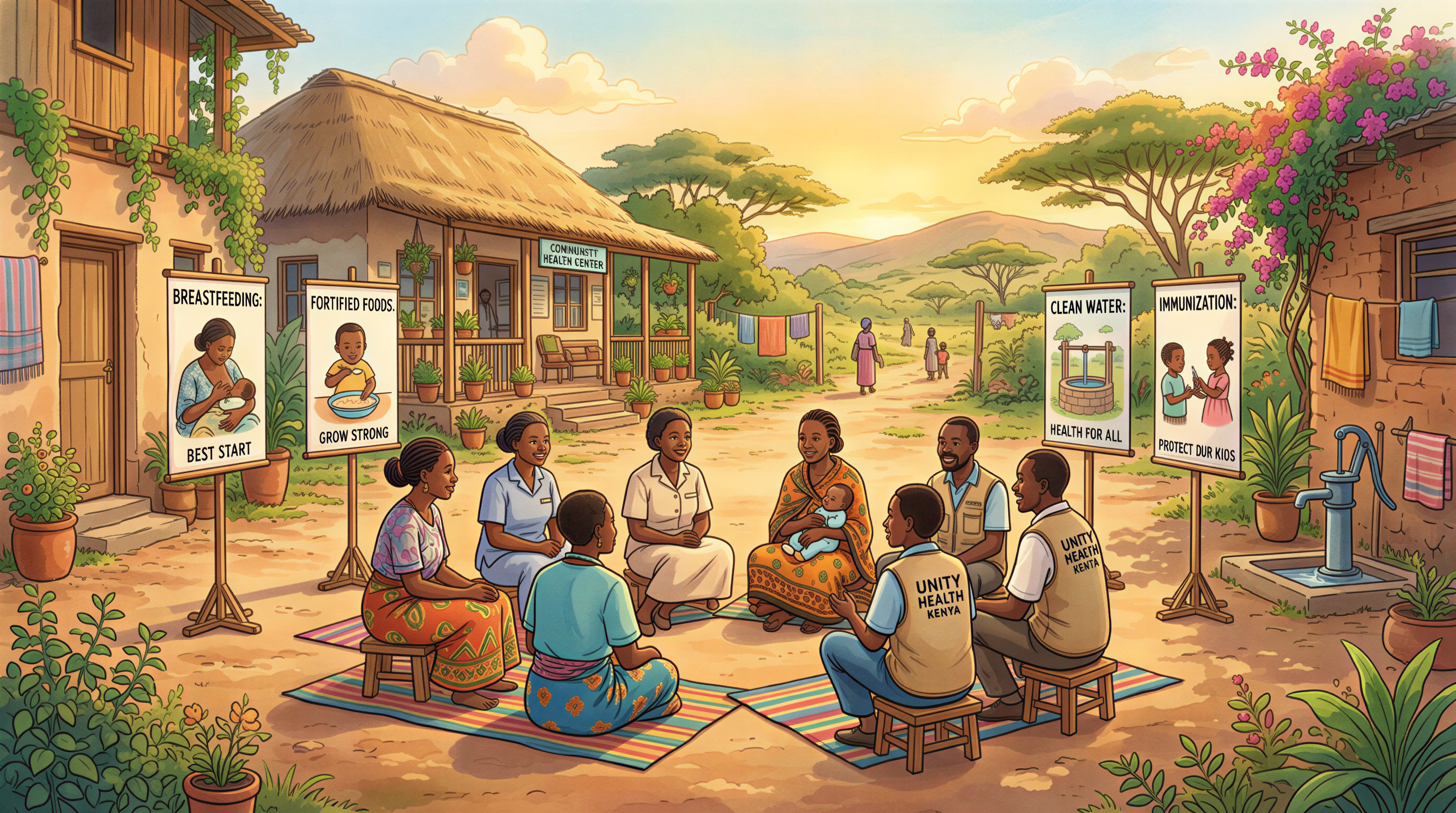
The frustrating part: we know what works. The Lancet Series on Maternal and Child Undernutrition spelled it out as far back as 2013. Ten interventions, properly delivered at scale, would cut stunting by an estimated 20–35% globally. We know:
- Promote exclusive breastfeeding for six months
- Improve complementary feeding from 6 to 24 months
- Manage acute malnutrition with RUTF
- Treat moderate acute malnutrition
- Maternal nutrition during pregnancy
- Iron-folic acid in pregnancy
- Calcium in pregnancy
- Zinc supplementation in diarrhoea
- Vitamin A from 6 months
- Iodised salt
That is the list. Cheap. Evidence-led. Mostly already in our national policy documents.
So why is one in five still stunted?
1. Coverage gaps. Each intervention reaches between 30% and 70% of the eligible children, depending on the county and the year. The math is brutal: an intervention that works at 100% reach in a trial works at 35% impact at 35% reach.
2. Quality gaps. A clinic that "delivers IFA" but does not have the conversation about how to take it is delivering paper, not impact.
3. Determinants outside the health sector. Stunting tracks with maternal education, household water access, sanitation, and food prices. The Ministry of Health does not control any of these. The interventions inside the clinic are necessary and not sufficient.
4. Funding cycles that fragment the work. A county might have a strong stunting program for three years funded by one donor, then a gap year, then a different donor with a different theory of change. The child does not pause growth between funding cycles.
5. The data delay. We measure stunting reliably through KDHS every five years. By the time the survey is published, the cohort is in primary school. Course-correction is always five years behind.

What's Missing From The Conversation
Three things — and these are the parts I want to push hard on.
1. The first-1,000-days framing has paradoxically narrowed the response.
Don't get me wrong: the 1,000-day window is real and the most efficient point to intervene. But it has trained programs, donors, and ministries to focus exclusively on the period from pregnancy to age two — and to neglect what happens before pregnancy and after age two.
A 14-year-old girl in Kitui who is iron-deficient and underweight will, in six years, become a pregnant woman. Her stunted-eligible child is being created now. The "adolescent girl gap" is the most underfunded piece of the stunting puzzle.
Likewise: catch-up growth between ages 2 and 5 is real and matters. Ignoring those years was an artefact of how we framed the science, not what the science says.
2. We treat stunting as a poverty problem and miss the literacy axis.
In KDHS data, maternal years of schooling is one of the strongest single predictors of child stunting — stronger than household income at lower-middle income levels. A mother with two more years of schooling is dramatically more likely to feed her child a diverse plate, complete the iron course, and seek care promptly.
This implies our most effective stunting interventions might not be in clinics. They might be in keeping girls in school past form 2, particularly in the highest-stunting counties.
We don't fund nutrition out of the education budget. We should.
3. The county-level political incentive is wrong.
A county governor running for re-election does not get rewarded for cutting stunting from 28% to 22%. Nobody mentions it on the campaign trail. They get rewarded for visible infrastructure: roads, dispensaries, sports. Stunting reduction is invisible until 25 years later, when the children are adults — and other politicians take the credit.
Until we change the political incentive — through ranking, public accountability, county-level scoreboards, or earmarked devolved funds — county governments will not prioritise stunting. They are not bad people. They are responding to incentives we set.
What Would Actually Move The Needle
If I had the pen, the policy ask would be:
- An adolescent-girl nutrition program that bridges school health and primary care — particularly in the 12 highest-stunting counties.
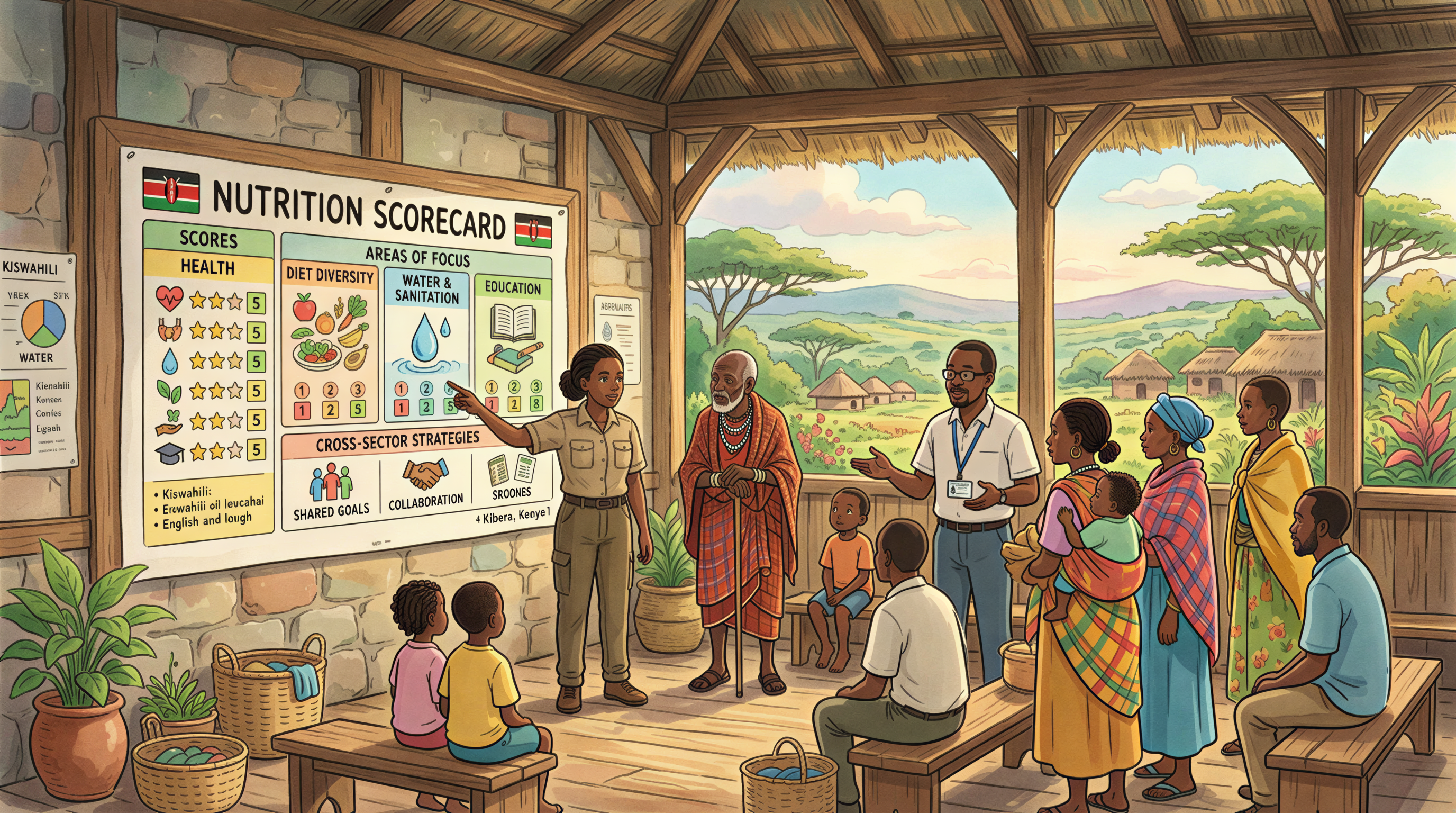
- Mandatory county nutrition scorecards published quarterly, with stunting rates, IFA coverage, and catch-up growth indicators. Boring, public, comparative.
- Education-budget-funded school feeding that meets minimum protein and micronutrient floors, not just energy floors.
- A real fortification audit regime so that fortified maize flour actually delivers what the bag claims. See the fortification piece.
- Cross-sectoral targeting — water, sanitation, education, and health interventions concentrated in the 12 highest-stunting counties for a decade. Not rotated. Concentrated.
We have stalled because we are still treating stunting as a clinical problem in a single ministry. It is a country problem in five ministries.
What This Means For Anyone Reading
If you work in nutrition: keep doing the clinical work. It still matters. But push your organisation to think across sectors — education, water, agriculture — not only across cadres within health.
If you work in policy: stop letting stunting be the orphan indicator at the bottom of the dashboard. It is the headline indicator of national human capital. Treat it accordingly.
If you are a parent or a citizen: ask your county government what its stunting rate is. Most do not know. The fact that this question is rare is the problem.
For the foundational picture, see the first 1,000 days, malnutrition in ASAL communities, and hidden hunger.
Stunting is not an act of God. It is a mathematics of choices we are making — county by county, year by year, budget line by budget line. The math has been worked out. The choices have not.
That is the real story.