Postpartum Nutrition: What the Textbooks Miss About Kenyan Mothers
Three days after delivery, every visitor asks about the baby.
Table of Contents
- What The Textbook Says
- What The Textbook Misses
- 1. The mother eats last and least
- 2. Sleep is destroying recovery
- 3. The first 6 weeks have specific food needs that get ignored
- 4. The cultural foods that work — and the ones that don't
- 5. Postpartum mental health and feeding are linked
- 6. The "breast is best" framing has flattened the postpartum nutrition conversation
- What A Better Postpartum Nutrition Conversation Would Cover
- Why I Wrote This
What The Textbook Says
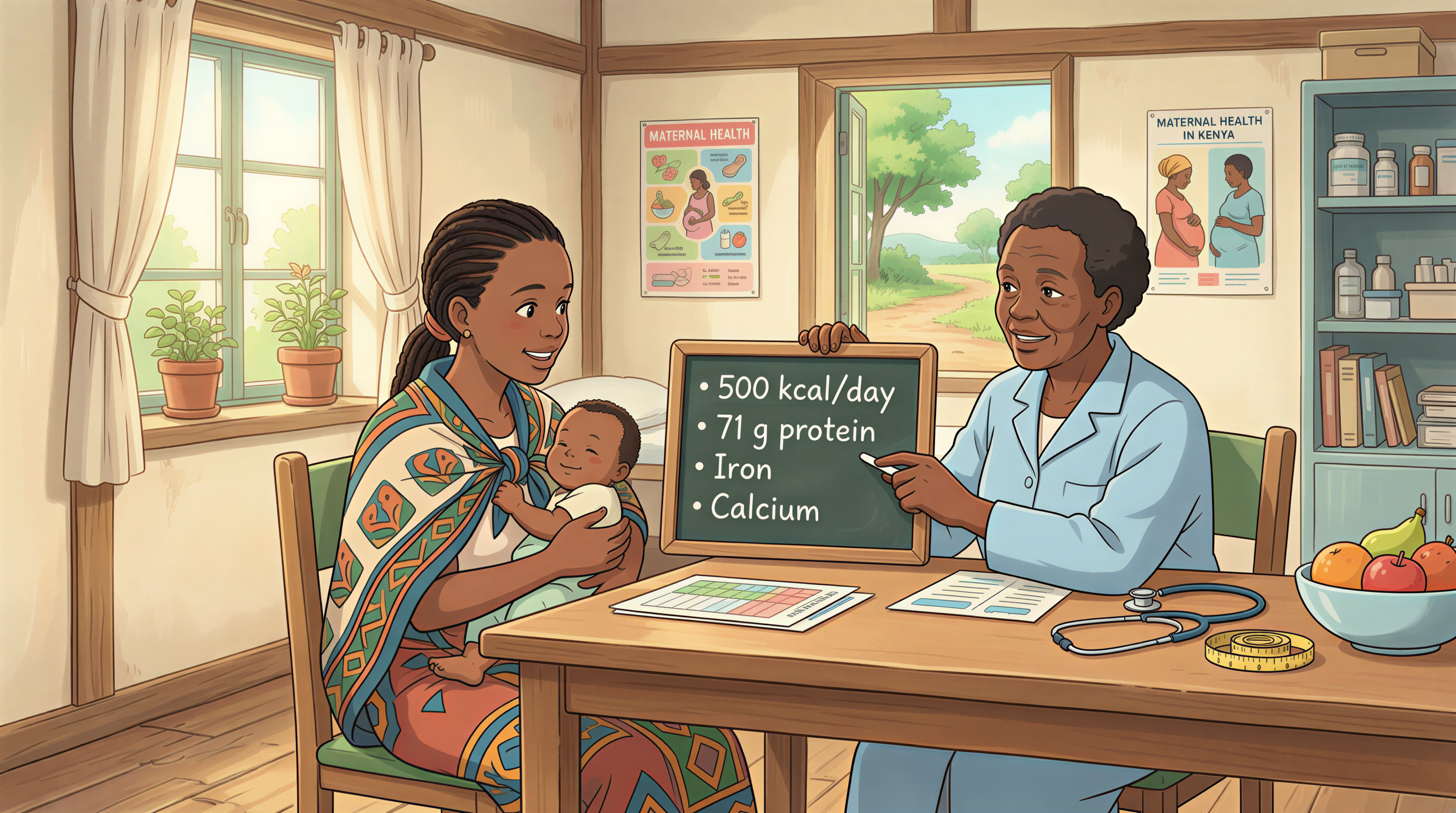
The standard clinical guidance, in roughly the form most Kenyan nutrition graduates absorbed it:
- A breastfeeding mother needs an additional 500 kcal/day
- Higher protein needs (~71 g/day vs 50 g for non-pregnant adult women)
- Iron stores need rebuilding after delivery (often a 6-month process)
- Calcium needs remain elevated to support breastfeeding
- Adequate hydration is critical for milk supply
- Continued folate, B12, iodine, vitamin D, and omega-3 needs
This is technically correct. It is also wildly insufficient as guidance for what actually happens in a Kenyan postpartum household.
What The Textbook Misses
Six things that show up in real households that the curriculum does not engage with.
1. The mother eats last and least
In many Kenyan households — across rural and urban contexts, across ethnicities, across income brackets — the postpartum mother eats after everyone else, often in smaller portions than the rest of the family. This is not because anyone is cruel. It is a cultural pattern in which the mother's recovery is assumed to be quietly self-managed.
Three weeks postpartum, the mother is the household member most under-fed relative to need. The textbook's "+500 kcal" assumes the mother is being served first and adequately. She is not.
The intervention is mostly social — direct family conversation about feeding the mother, ideally led by health workers who have explicitly named this pattern. CHV training that addresses this pattern as an active intervention has more impact than additional micronutrient supplementation.
2. Sleep is destroying recovery
Postpartum sleep is fragmented, short, and often involves sole-caregiver waking. The cumulative sleep debt by week six is staggering. Sleep deprivation impairs glucose regulation, immune function, milk supply, and emotional regulation.
The textbook does not address this. The clinical practice rarely does either. The cultural norm of "the mother handles the night" is rarely interrogated as a nutritional issue.
3. The first 6 weeks have specific food needs that get ignored
The "fourth trimester" — the first 6–8 weeks postpartum — has specific recovery requirements that don't fit a generic adult nutrition profile:
- Iron and protein for tissue healing (especially after C-section or significant tearing)
- Higher fluid intake to support milk supply and replace blood volume
- Easily-digested foods, since many mothers have postpartum gut and pelvic floor changes
- Foods that support hormonal regulation through the lactation transition
Traditional Kenyan postpartum foods often address these well — some better than the modern "balanced diet" advice. Uji wa wimbi or uji wa ujimbi made with milk and groundnuts. Soups (mtumbo, beef, chicken) that combine protein, hydration, and digestibility. Sweet potatoes, ripe bananas, papayas. The traditions are smarter than the clinical handout.
4. The cultural foods that work — and the ones that don't
Across Kenyan cultures, there are postpartum food traditions worth keeping and traditions worth gently dropping.
Worth keeping:
- Uji wa wimbi or wa mtama (millet/sorghum) with milk — high in iron, calcium, B vitamins, and gentle on a recovering gut
- Soups with bones and meat — protein, hydration, easily digested
- Groundnut paste in porridges — calorie density and protein
- Eggs daily — protein, iron, choline (important for the breastfed baby)
- Soft sweet potato or pumpkin — vitamin A, gentle starches
- Papaya and banana — easy fruit, fibre
Worth dropping or modifying:
- "No vegetables for the first month" — this is a real tradition in some communities, with no clinical basis. Greens accelerate healing.
- "Avoid water until milk comes in" — actively harmful. Hydration is essential.
- "Cold foods are dangerous" — depending on what's meant. Cold ugali is fine. Cold drinks during a feeding session are also fine. The cultural framing here is mostly imported folklore.
- Excessive uji at the expense of protein — uji is comforting and fluid-heavy, but a postpartum diet that is mostly uji and sukuma is protein-light.
The textbook treats culture as superstition to be overcome. The honest clinical view is more discriminating: some traditions are excellent, some are folklore, and the role of the nutritionist is to identify which is which without being patronising.
5. Postpartum mental health and feeding are linked
A postnatal-depressed mother eats less, eats worse, and produces less milk. This is observable and well-documented. Most Kenyan postpartum care does not screen for postnatal depression at all. The first ANC postnatal visit is mostly about the baby.
The honest version of postpartum nutrition guidance has to include mental health. Recommending three meals a day to a mother who has not slept four consecutive hours in five weeks and who feels disconnected from her infant is well-meaning and useless. The intervention has to be wider than the plate.
6. The "breast is best" framing has flattened the postpartum nutrition conversation
This will be controversial. I'll say it carefully.
Exclusive breastfeeding for six months is the public health gold standard. It is supported by strong evidence. I will not relitigate that.
But the way "breast is best" has been delivered in Kenyan public health has, in some implementations, suppressed the conversation about what the mother needs to eat to sustain breastfeeding. The focus on the baby's feeding has overshadowed the mother's. A breastfeeding mother who is undernourished produces enough milk for the baby in the short term — at the direct cost of her own bone, muscle, and micronutrient stores. We are seeing this in maternal anaemia and bone density data five years out from delivery.
The corrective is not to weaken breastfeeding promotion. It is to dramatically strengthen the maternal nutrition support that runs alongside it. Currently, that support is uneven.
What A Better Postpartum Nutrition Conversation Would Cover
If I had a 30-minute conversation with a postpartum mother in any Kenyan clinic, here is what would be in it.
Week 1–2 priorities:
- Eat. Often, more than feels right.
- Drink water with every feed.
- Soft, dense foods (uji with milk and groundnut paste, soups with bones).
- Bowel movements and pelvic floor — not optional topics, even if uncomfortable.
- Sleep when possible. Family must adjust.
Week 3–6 priorities:
- Add greens (managu, kunde, sukuma) — cooked, with oil for absorption.
- Iron rebuild — eggs daily, omena 2–3x a week, beef liver weekly.
- Continue iron-folate tablet for at least 3 months postpartum.
- Begin gentle movement — walking, no formal exercise yet.
- Mental health check — direct, non-judgemental.
Month 2–6:
- Return to a normal varied plate, with continued protein emphasis.
- Sustained hydration.
- Plan for any return-to-work transition that doesn't compromise feeding.
- Schedule a 6-month postpartum nutrition review — this almost never happens in Kenyan clinical practice and should.
For the related conversation on maternal nutrition, anemia in pregnancy, and the first 1,000 days, the postpartum chapter is the most under-discussed. We have built strong frameworks around pregnancy and infant feeding. The bridge between them — the mother's body, in the months after delivery — has been left half-funded and half-described.
Why I Wrote This
Because too many Kenyan postpartum mothers are recovering on uji and sukuma alone, six weeks into delivery, with no further nutrition contact until the next pregnancy. Because the textbook version of postpartum nutrition is technically right and practically useless. Because the cultural traditions are smarter than the curriculum often gives them credit for, and the harmful folklore is rarer than the curriculum often assumes.
And because the silence around the question "what did the mother have for lunch" is a measurable nutritional gap that any Kenyan clinical system can begin to close — at no additional supplementation cost — by simply having the conversation.
Ask. The answer matters.