Maize Flour Fortification Is Mostly Theatre. Here's Why.
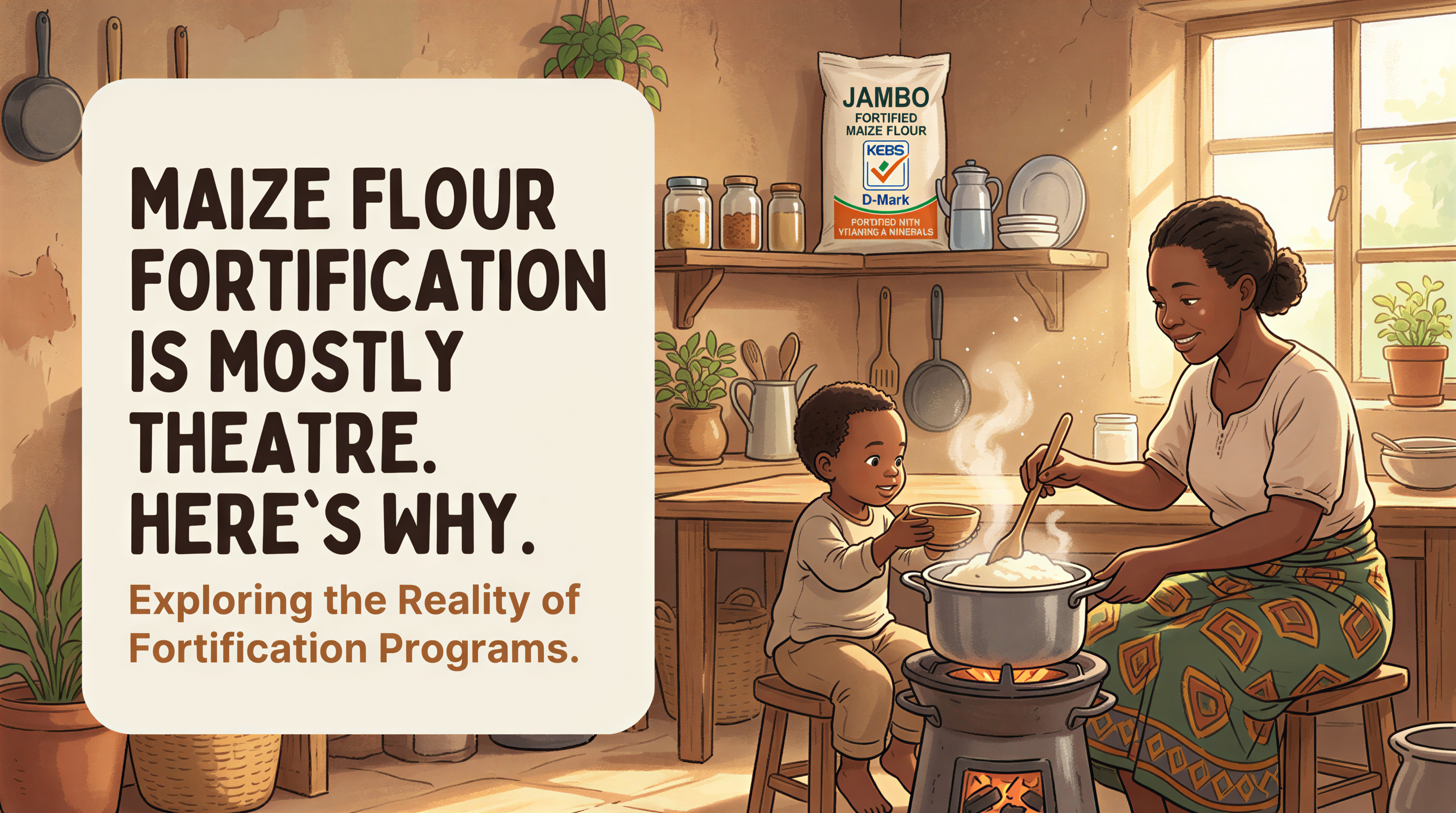
A bag of unga sits on a Naivas shelf. The label says: "Fortified with iron, zinc, folic acid, and vitamins B1, B2, B6, B12."
The KEBS standardisation mark is in the corner. The price is competitive.
You take it home. You make ugali. You feed your child. You believe — reasonably — that the iron and zinc your child needs is in the meal you just served.
Sometimes that is true. Sometimes it is not.
This is the maize flour fortification story in Kenya. It is mostly theatre. Here is why.
Table of Contents
- What Mandatory Fortification Was Supposed To Do
- What Actually Happens At The Mill
- Why Compliance Is Bad
- What This Costs
- What A Working Regime Would Look Like
- What To Do Until Then
- Why I Wrote This
What Mandatory Fortification Was Supposed To Do
Kenya made fortification of maize meal mandatory in 2012. The logic was straightforward and globally well-evidenced: ugali is the staple. If you fortify the staple with iron, zinc, folic acid and B vitamins, you can move millions of micronutrient-deficient people up the curve at very low cost. Each fortified bag adds a few cents to the production cost. The public health return is enormous.
Countries that have done this well — Costa Rica, Chile, parts of Latin America — have moved national iron and folate status meaningfully within a decade.
Kenya wrote the policy. We did not build the audit regime to enforce it.

What Actually Happens At The Mill
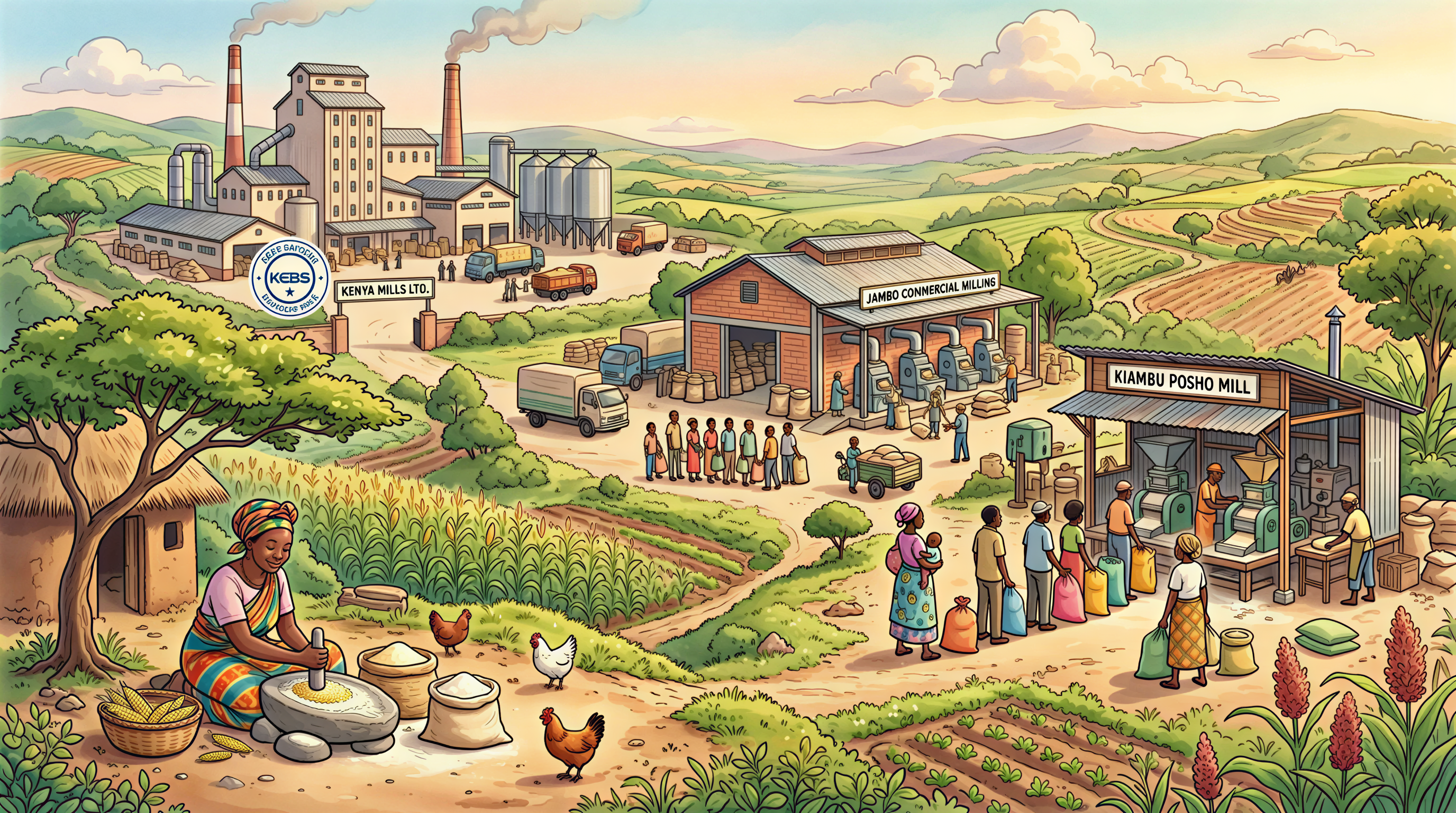
There are roughly four categories of maize miller in Kenya:
- Large industrial mills — well-equipped, branded, retail-supermarket-bound.
- Mid-sized commercial mills — supplying regional supermarkets and bulk buyers.
- Posho mills — small village-level or peri-urban mills, the majority of Kenyans' actual flour source.
- Smallholder home grinding — declining but still relevant in some counties.
Mandatory fortification, as written, applies to large and mid-sized commercial millers. It does not apply to posho mills or home grinding. So at the level of national flour consumption, mandatory fortification covers — at most — perhaps 50–60% of the maize meal Kenyans actually eat.
That is the first crack. Most Kenyan rural households are eating unfortified flour by definition.
The second, larger crack: at the large mills that are required to fortify, compliance is patchy.
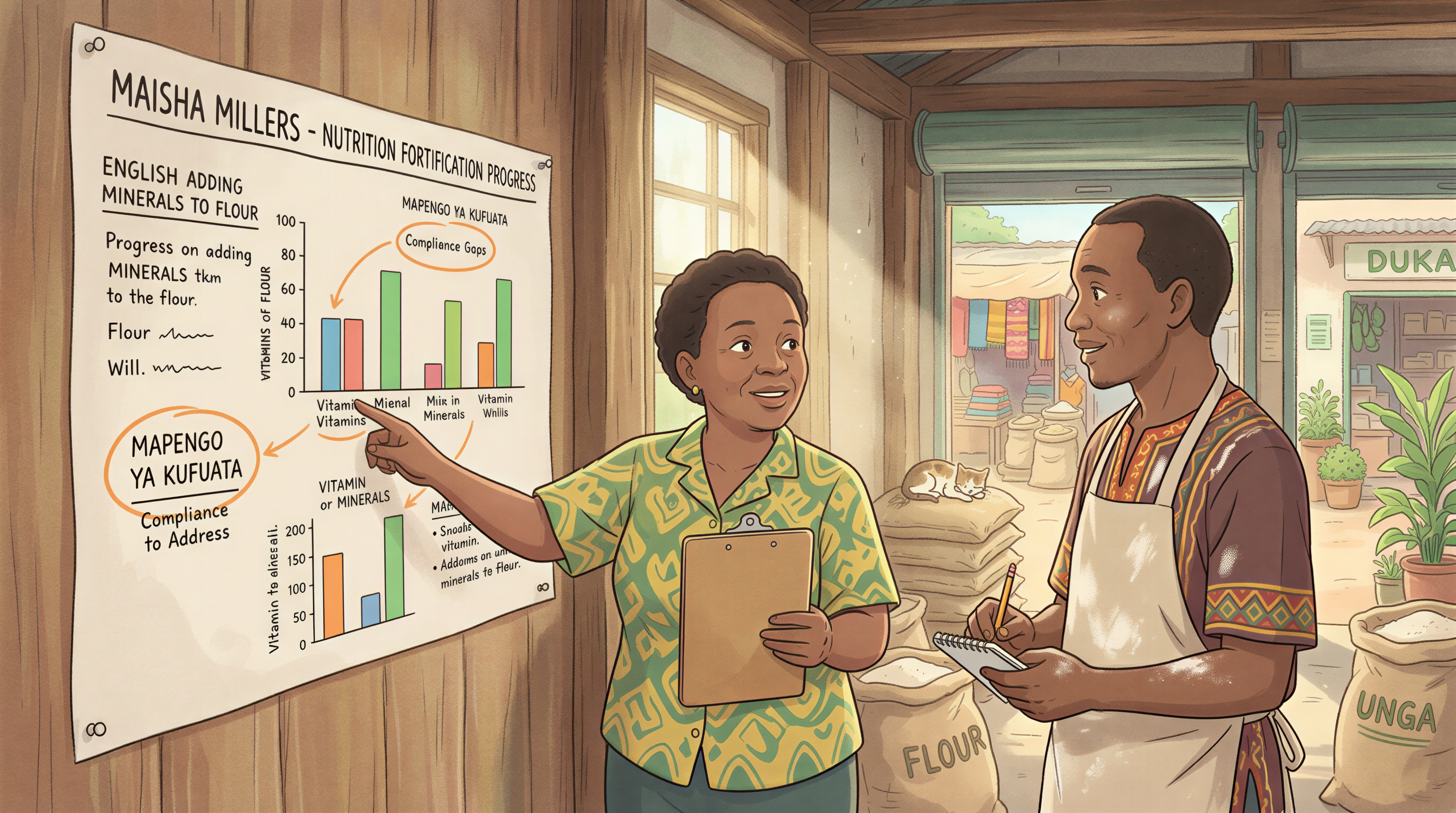
A 2018 KEBS-supported study of fortified maize meal in Kenya found that only about 30–40% of branded fortified maize flours met the mandatory iron content threshold at the point of testing. A 2021 sub-study in the Lancet Global Health found similar gaps. Some products had 80% of the declared iron. Some had less than 20%. Some had nothing detectable.
The bag claimed fortification. The flour did not deliver it.
Why Compliance Is Bad
Three reasons.
1. The audit regime is under-resourced.
KEBS has a finite number of inspectors and a finite number of laboratory tests. Routine monitoring of fortification levels at scale — across hundreds of mills, multiple production batches per week — would require a national programme that currently does not exist with sustained funding.
2. The premix is expensive and tempting to skim.
The fortification premix (the iron-zinc-folate blend) is one of the more expensive inputs in milling. A miller under price pressure has a continuous incentive to underdose, skip a batch, or use a cheaper premix that doesn't meet specification. Without testing, no one knows.
3. The penalties don't bite.
When non-compliant products are detected, the regulatory response is usually a written notice, occasional withdrawal of certification, rarely a public naming. There is no equivalent of a tobacco-warning system. There is no public dashboard. The miller's reputational and financial cost of non-compliance is small.
What This Costs
The micronutrient gap fortification was supposed to close has not closed.
- Kenya's maternal anaemia rate has barely moved since 2012.
- Childhood iron-deficiency anaemia remains widespread despite a decade of "fortified" flour on shelves.
- The hidden hunger picture — see hidden hunger Kenya and iron, zinc, vitamin A — has shifted modestly, far less than the policy promised.
We built the policy. We told households the food would deliver the nutrients. The food has been delivering perhaps half of what was promised, and that is a generous estimate.
This is not a failure of biology or evidence. It is a failure of audit.
What A Working Regime Would Look Like
The international playbook is well-established. Six pieces:
1. Routine batch testing at the mill.
Every commercial mill, weekly random batch sample, sent to an accredited lab. Results published.
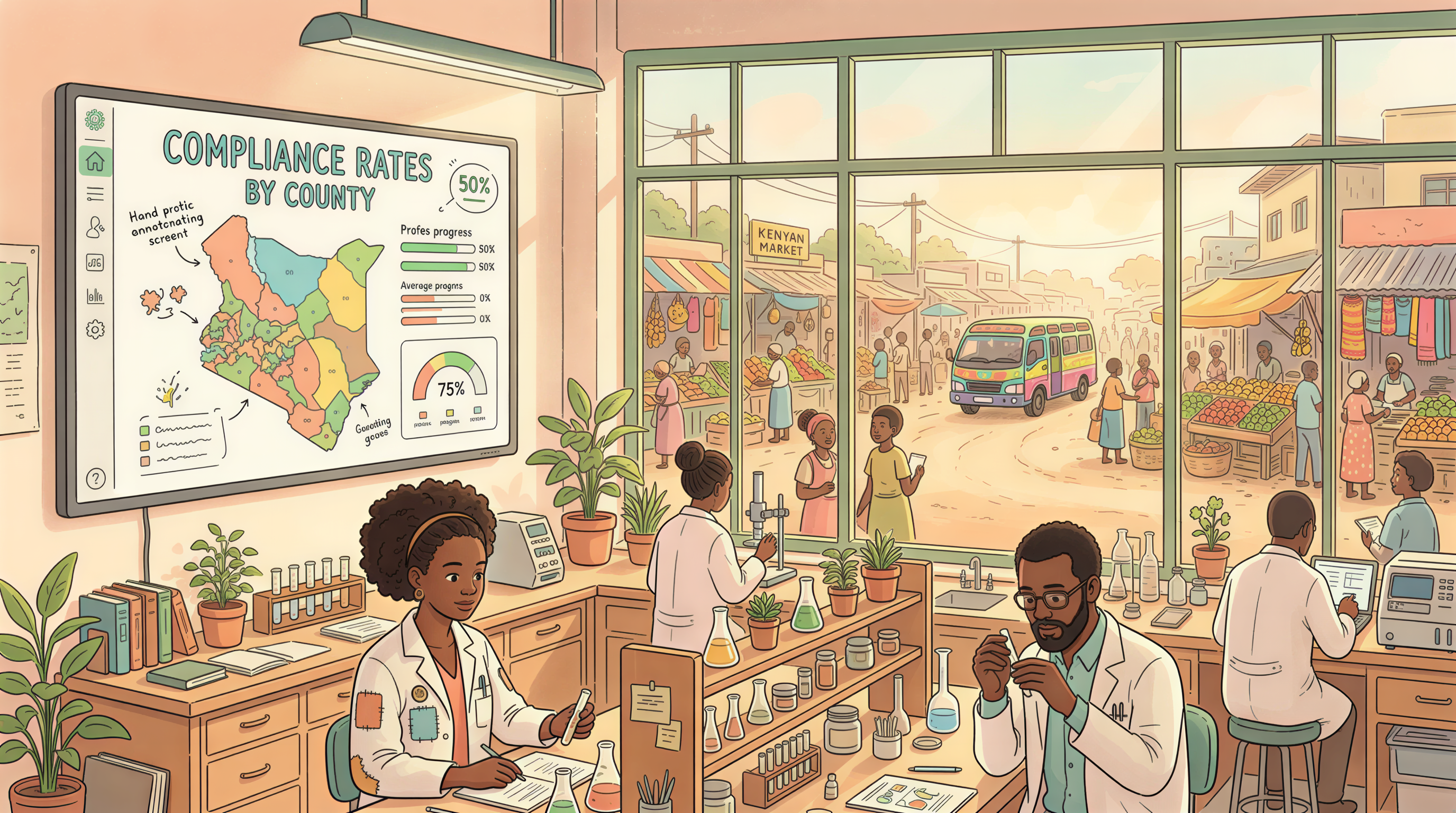
2. Public, county-level dashboards.
A monthly public dashboard showing compliance rates by miller, by product, by county. Boring, public, comparative. The fact that this is rare is exactly why the system fails.
3. Premix supply chain auditing.
The premix itself must meet specification. Audit the supply chain, not just the end product.
4. Penalties with teeth.
Loss of KEBS certification for repeated non-compliance. Public listing of repeat offenders. A standardised fine schedule. Withdraw the standardisation mark for the bag, not just the brand.
5. Bring posho mills into the system.
Subsidised premix for posho mills. Training for operators. A public health imperative requires reaching the mills that feed the most Kenyans, not just the supermarket-aisle ones.
6. Independent verification.
A third-party academic or civil society verification programme that publishes annual reports. Independent of the regulator. Independent of the industry. The two should not also be the auditors of each other.
This is not a billion-shilling investment. The cost of doing this properly is a tiny fraction of the public health cost of the gap.
What To Do Until Then
For households reading this:
- Don't rely on fortification alone. Add omena, beef liver (once a week), kunde, eggs, beans to your iron-week. See the iron piece.
- For pregnant women: the IFA tablet conversation matters more than which brand of unga you buy.
- For children: the diversified plate beats relying on the bag.
For policy people reading this:
- The fortification audit regime is the highest-return public health investment we are not making.
- It is also the easiest to design — the playbook exists.
- The reason it is not happening is political will, not technical capacity.
Why I Wrote This
Because we built a policy that should have moved national health outcomes, told a country it was working, and then spent a decade not measuring whether it worked.
The mothers buying fortified unga in Kawangware deserve a regulator that delivers the nutrients on the bag. The mills already complying deserve to compete with mills that also have to comply. The public deserves to know which brands meet the standard and which do not.
Right now, none of this is happening. The bag still says fortified. The flour still might not be.
That is theatre. We can do better.