Sleep, Stress, and What's on Your Plate: A Kenyan Wellness Reality Check
You're tired and irritable.
You blame "the diet."
It might be six hours of sleep, three hours of Nairobi traffic, and a phone you check 87 times a day.
Most of what gets diagnosed in my private practice as a "weight problem" or a "diet problem" is, on closer inspection, a sleep-and-stress problem with food downstream. Fix the upstream and the downstream often resolves itself. This is the conversation that nutrition writing avoids because it doesn't sell tubs of anything.
So.
Table of Contents
- The Loop, In Plain Terms
- The Sleep Math
- What The Stress Side Looks Like
- What I Actually Tell Clients
- What Will Probably Change
- What Doesn't Work
- The Plate, Once The Foundation Is Set
- Why I Wrote This
The Loop, In Plain Terms
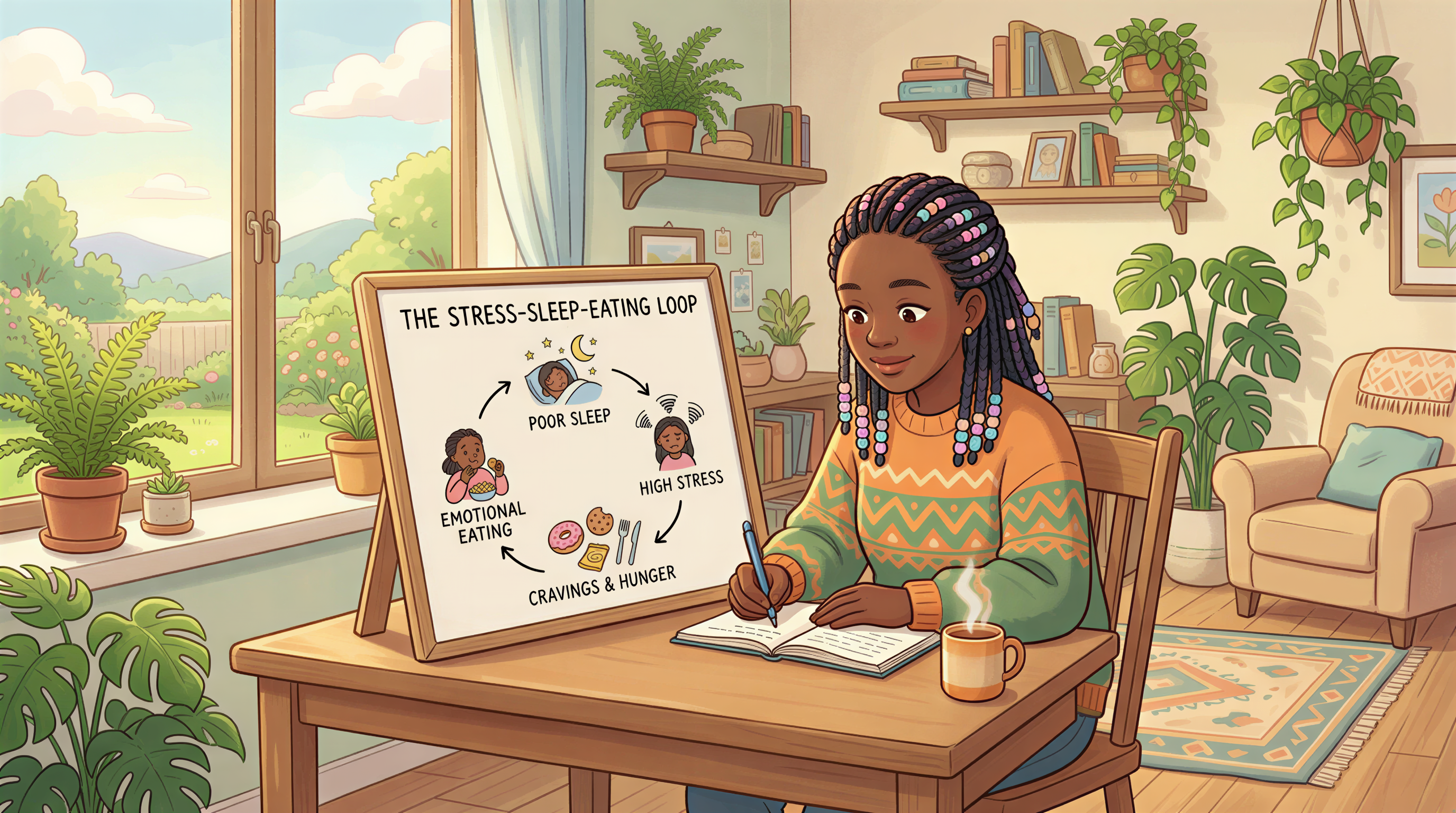
There is a clinically well-described feedback loop between sleep, stress, and eating behaviour. It runs roughly like this:
- Insufficient sleep raises ghrelin (hunger hormone), lowers leptin (fullness hormone), and reduces prefrontal cortex regulation. You wake up genuinely hungrier and worse at saying no to mandazi.
- Chronic stress raises cortisol. Persistently elevated cortisol drives visceral fat accumulation, increases cravings for hyper-palatable food (sugar, fat, salt combinations), and disrupts insulin sensitivity over months.
- Poor eating — high refined carbs, irregular timing, low protein — destabilises blood sugar, which worsens sleep quality and stress reactivity, which worsens eating.
- The loop tightens.
Most of my clients arrive trying to break the loop at the food point. That is the hardest entry. Sleep and stress are easier and more powerful entry points, and almost no one targets them first.
The Sleep Math
Average self-reported sleep for working-age Nairobians is around 6 hours and 15 minutes a night. Recommended adult sleep is 7–9 hours. We are running, on average, more than an hour short, every night, every year, for years.
What an hour-short-of-sleep does to your eating, on average:
- 200–300 additional calories consumed the next day
- 30% increase in cravings for sweet and salty foods
- Lower satiety from the same meal
- Worse blood sugar control after meals
- Reduced gym performance and recovery
The kicker: an hour-short-of-sleep also impairs your judgement about how short of sleep you are. Most chronically under-slept people feel fine because they have forgotten what fully rested feels like. They diagnose themselves as needing more coffee, not more sleep.
The fix is rarely "sleep more." It is "shift the bedtime." A bedtime moved from 12:30 AM to 11:00 PM, held for two months, changes more about your eating than any meal plan.
What The Stress Side Looks Like
Stress in 2026 Nairobi is not abstract. It is a specific stack:
- Nairobi traffic — 60–90 minutes a day for most middle-class adults
- A workplace operating at 30% above sustainable load
- A phone delivering 200+ notifications a day
- Financial pressure that compounds at month-end
- Family or caregiving responsibilities that don't pause for any of the above
Each individual stressor is manageable. The stack is not. The stack is what produces the pattern I see in clients: 11 PM scrolling, 2 AM waking, 6 AM alarm, 11 AM mandazi, 4 PM Lucozade, 9 PM ordering food, repeat.
Importantly: the food choices in this stack are not character failures. They are predictable physiological responses to a specific load profile. You will not out-discipline your way through it. You will only restructure your way through it.

What I Actually Tell Clients
A two-week reset that targets the loop at the right entry points.
Week 1: Sleep
- Lights out by 11 PM. No exceptions. Phone in another room. Read a book on paper if needed.
- No caffeine after 2 PM. Including the office mandazi-tea round at 4.
- Last meal by 8 PM. Late eating wrecks sleep architecture even when you sleep through it.
- Sunlight in the morning. Five minutes outside before 9 AM resets your circadian clock — meaningful for chronic Nairobi insomniacs.
That's it. Don't change food yet. Two weeks of better sleep alone shifts about a third of clients' eating without further intervention.
Week 2: Stress
Add to the sleep changes:
- One protected break of 20+ minutes every workday. No phone. Walk if possible.
- One zero-screen evening per week. Read. Cook with your hands. Stare at the ceiling.
- Twenty minutes of any movement five days a week — walk, stretch, anything. Not optimisation. Just movement.
- One meal eaten without a screen every day. Most Nairobi desk workers eat 14 of 21 weekly meals while looking at a screen. Reduce.
Two weeks. Don't track calories. Don't change diet rules. Sleep and stress, alone.
What Will Probably Change
In the population of clients I have run this protocol with — perhaps 50–60 over the years — the typical outcomes after two weeks:
- The 11 AM mandazi pull weakens by about half
- Sugar cravings decrease meaningfully
- Energy in the afternoon improves
- Some weight loss appears (1–2 kg) without any food restriction, mostly from reduced calorie intake driven by better appetite regulation
- Alcohol consumption often drops, often unintentionally
- Sleep quality improves enough that the person becomes annoyed at how short their sleep used to be
Then, in week three, with these foundations in place, food changes become straightforward. You are no longer fighting biology. You are working with it.

What Doesn't Work
Predictably, the things that don't work in this space:
Melatonin alone. Helps for jet lag. Does not solve chronic sleep deprivation in adults with normal circadian rhythms. Has been over-prescribed in Nairobi.
Adaptogens, ashwagandha, "stress vitamins." Some have modest effects. None replace the structural stressor changes. The KSh 4,500 a month is mostly placebo + retail margin.
Meditation as a sole stress intervention. Meditation is real and useful. It does not, by itself, solve the structural issues if you are still doing 90 minutes of traffic, 11 hours of work, and 2 hours of phone. Stack it with the structural changes.
More coffee. This is what most of my clients try first. It compounds the sleep problem and the stress problem. Cap at two cups by lunch.
Diet changes as the entry point. This is the deepest mistake. You are trying to change behaviour against a biology that is sleep-deprived and cortisol-flooded. The diet plan is fighting the wrong battle.
The Plate, Once The Foundation Is Set
When sleep and stress are roughly in order, the food plan that works is also boring:
- Protein at every main meal — see strength training protein
- Vegetables at lunch and dinner
- Two fruits a day
- Water sufficient for hydration
- Carbohydrates appropriate to your activity, not influencer-defined
- One meal a week that is purely social and unjudged
This isn't a plan you'll find in a programme. It's the boring middle distance of human eating that most people get to once they stop trying.

Why I Wrote This
Because too much nutrition writing in 2026 sells food protocols to people whose actual problem is upstream of food. The protocol fails. The client blames themselves. The cycle repeats.
The cycle is not a personal failure. It is a stack of misdiagnoses that pretend the body and life are separable. They are not.
For the related lifestyle plate, see the corporate desk diet and what I actually eat in a week.
Fix the sleep. Fix the stress. The plate will surprise you. It usually does.